Trakošćan castle mirrored in its forest lake — the most photographed corner of Zagorje, inland Croatia
Main guide · Inland Croatia

Inland Croatia — the country tourists never see

The coast is what Croatia sells. The inland is where Croatians live. A Croatian insider guide to Slavonia, Zagorje and Lika — half the price, twice the welcome, no crowds.

By Blazenka Last updated 2026-05-25 14 min read
Scroll
B

Blazenka

Blazenka is Croatian, from inland Croatia — from the Slavonia region. She lived in Zagreb for years and has travelled to the coast nearly all her life. She splits her time between Denmark and a slow loop through her home villages, and insists that the country tourists see is the wrong half.

"The coast is what Croatia sells. The inland is where Croatians live. Spend one of your weeks here and the country becomes a different country."

Updated 2026-05-25 · Prices verified 2026-05-25

When people say "Croatia" they picture Split, Dubrovnik, Hvar — a thin strip of Adriatic coastline a few kilometres wide. But most Croatians do not live by the sea. The country stretches hundreds of kilometres inland: fields, river towns, vineyards, castle hills, karst plateaus, family Sunday dinners that last four hours. That is the actual Croatia. And it is precisely the part international tourists never see.

~90 %
Tourists stay on the coast
3 regions
Slavonia · Zagorje · Lika
½ price
vs. coastal accommodation
~0 queues
Real tourist density inland
01 · Overview

The three inland regions — pick one

The maths is simple. Roughly 20 million tourists visit Croatia every year. More than 90 percent of them stay within 30 kilometres of the coast. Move two hours inland from any port town and the foreign-tourist count drops to near zero.

"Inland Croatia" is not one place. It is three very different regions with different landscapes, food, dialects and rhythms. You cannot reasonably do all three in one trip — they are spread across 400 kilometres east to west. Pick one. The rest of this guide treats each region in turn and then ties them together with food, planning and a one-week itinerary. If the capital is part of your plan as well, two nights in Zagreb pairs naturally with any of the three.

Vineyards on the Danube slopes near Ilok in eastern Slavonia Eastern plains

Slavonia

Best for: river-fish lunches, paprika sausage, Danube vineyards, the lowest tourist density in the EU. Central European, not Mediterranean.

Zagreb — 3h east by car
Veliki Tabor — pentagonal medieval castle in the rolling green hills of Zagorje Castle country

Zagorje

Best for: hilltop castles, small wine cellars, thermal spas, fairytale-Europe scenery 40 minutes from Zagreb. The easiest inland day-trip.

Zagreb — 40 min north
Northern Velebit karst mountains above the Croatian coast — Lika highland Mountains + Plitvice

Lika

Best for: Plitvice done properly, empty hiking trails, lamb under the bell, brown-bear country between the coast and the inland.

Zagreb — 2h south on the A1
02 · Eastern plains

Slavonia — the eastern breadbasket

This is Blazenka's home area. And it is the most different from anything else you have seen in Croatia.

The coast is Mediterranean. Slavonia is Central European. Different food, different architecture, different rhythm, different language register. Crossing from Split to the eastern plains feels like crossing a border.

The landscape is flat. Two great rivers shape it: the Sava in the south and the Drava in the north, both running roughly east toward the Danube. Between them sit the agricultural plains — corn, sunflower, wheat, paprika, vineyards on the gentle slopes near Đakovo and Ilok. The skies are huge. You can drive for forty minutes between villages and meet maybe three other cars.

What you actually do here:

The towns here have classic Austro-Hungarian centres — pastel facades, a main square with a bandstand, a baroque church. They are not "preserved for tourists"; they are simply still in use. Markets run on Tuesdays and Fridays. Prices are roughly half of the Dalmatian coast: a coffee is €1.20, a beer €2, a plate of grilled meat with sides €8.

Eat Slavonian, drink Slavonian — both day and night

The biggest mistake foreign visitors make in Slavonia is ordering coastal food. Skip the grilled squid and the olive-oil tomato salad — they exist on the menu, but they are travel-card food. Order kulen with cottage cheese as a starter, fiš paprikaš or čobanac as a main, orahnjača (walnut roll) for dessert, a glass of Graševina throughout. Tell the waiter you want to eat what their grandmother cooks. The price drops, the food improves, the kitchen team takes a personal interest.

Bučje village panorama — Slavonian rural settlement with farmhouses, fields and forest behind
A Slavonian village from the road in. The villages here are not preserved — they are still in use.
03 · Castle country

Zagorje — castle country north of Zagreb

Drive forty minutes north of Zagreb and the landscape changes completely. The easiest inland region to combine with a city visit.

The motorway gives way to twisting country roads, and the horizon fills with small green hills, each topped with a church or a castle. This is Hrvatsko Zagorje — the most "European fairy-tale" part of Croatia.

The two anchor sights are castles. Trakošćan, the more famous one, sits in a romantic 19th-century reworking of a medieval fortress, mirrored in its own lake, surrounded by a forest park you can walk in for hours. Veliki Tabor, twenty minutes away, is rougher and older — pentagonal walls, four round towers, more atmosphere than polish. Both are open year-round, both charge around €5 entry, both reward an unhurried morning.

Between the castles, the region runs on wine and thermal water. Small klet — traditional wooden wine cellars — dot the hills, many open to walk-in visitors for a tasting flight. The Krapinske Toplice and Tuheljske Toplice spa complexes are popular weekend destinations for Zagreb families; outside Croatian school holidays they are almost empty during the week.

Food here is the most Austro-Hungarian in the country. Štrukli — baked or boiled rolls of thin dough filled with fresh cottage cheese — is the regional dish. Pair it with a glass of crisp local Pušipel. Purica s mlincima (turkey with thin baked pasta) is the Sunday classic. Cakes are heavy, German-style: apple strudel, walnut roll, kremšnita custard slice.

Zagorje is the easiest inland day-trip if you are short on time — a single day from Zagreb is enough to see one castle, taste wine at a small producer, and have lunch in a village inn. If you have three days, base yourself in a country guesthouse and ignore the car entirely between meals. Spend two nights in Zagreb — Upper Town, Dolac market, a slow dinner — then drive an hour north and disappear into the hills.

The coast is what Croatia sells. The inland is where Croatians live. Blazenka
04 · Mountains + Plitvice

Lika — Plitvice country and the karst plateau

Almost everyone who visits Croatia passes through Lika without realising it. The A1 motorway from Zagreb to Split cuts straight across this region.

Most travellers stop only at Plitvice Lakes, take their photographs, get back in the car and continue to the coast. That is a mistake worth fixing.

Lika is the karst highland — limestone plateau, sinkholes, underground rivers, dense forests of beech and fir. The population density is the lowest in Croatia. Villages are small and far apart. The wildlife list reads like a different country: brown bear, wolf, lynx, golden eagle. You will not see them from the road, but you will feel that you are somewhere wilder than the coast suggests.

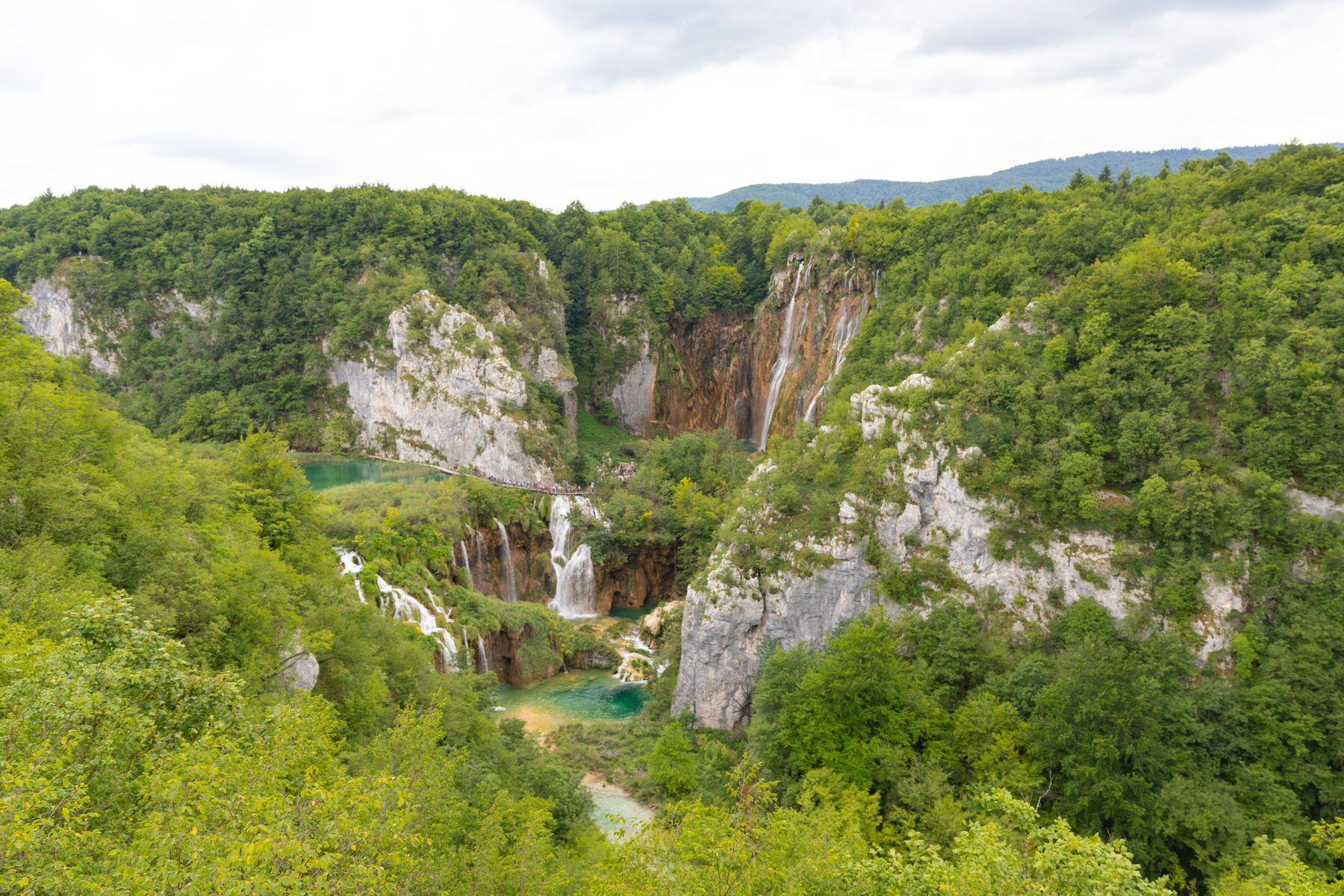
Plitvice itself deserves a full day, not the three hours most tour buses allocate. Arrive at opening (07:00 in summer), do the long upper-lakes loop before the crowds, eat lunch outside the park, then return for a quiet late-afternoon walk on the lower lakes. The light at 17:00 is better than the light at 11:00, and the boardwalks are half-empty. The full strategy is in our Plitvice Lakes guide.

Beyond Plitvice, the region rewards slow travel:

Lika is also the easiest inland region to combine with a coastal trip — the motorway makes it a natural stop between Zagreb and Split. The trick is to actually stop. Sleep one night in a guesthouse near the park rather than driving straight through.

!

Rural roads in winter — bura, ice, deer

From November through March, inland driving is not coastal driving. The bura wind that closes coastal motorways above the A1 is the same wind that scours the Lika plateau. Snow and black ice are normal between Plitvice and the inland villages from December to February. Country roads in Slavonia and Zagorje carry deer at dawn and dusk in autumn. If you are visiting between late November and early March, take winter tyres (legally required in Croatia from 15 November to 15 April), keep half a tank, and accept that 60 km/h on a country road is a healthy speed.

Plitvice Lakes — boardwalks and turquoise pools in Lika
Dedicated guide

Going to Plitvice? Lika is the right base.

Most travellers see Plitvice as a three-hour stop between Zagreb and Split. We treat it as a two-night Lika base — guesthouse outside the park, early entry, lamb under the bell at lunch, Rastoke on day two. The full plan is in the Plitvice guide.

Read the Plitvice Lakes guide
05 · Food

Food culture — paprika, river fish, kulen, štrukli

The single biggest surprise for first-time inland visitors is the food. It is an entirely different kitchen from the coast.

Coastal Croatian cuisine — olive oil, grilled fish, tomatoes, the Mediterranean trinity — is what tourist menus serve. Inland descends from the Austro-Hungarian Empire and the Pannonian plain, and it leans on pork, paprika, cabbage, freshwater fish, baked dough and dense cakes.

The essentials worth tracking down:

A few Croatian phrases that pay for themselves: dobar dan (good day), hvala (thank you), molim (please / pardon), račun, molim (the bill, please), živjeli (cheers). Locals are genuinely pleased by the attempt — far more than on the coast, where staff hear thirty languages a day.

06 · Planning

How to plan an inland week

A workable one-week inland itinerary, assuming you arrive at Zagreb airport with a rental car.

Pick one of the eastward or southward legs — do not try to do both in a week. Sleep in small guesthouses or agroturizam rather than hotels. Eat lunch in villages, not at motorway service stops. Buy fruit at a market at least once.

For accommodation, Booking has a thinner inland inventory than it does on the coast, but what is there tends to be excellent and cheap:

For agroturizam (working-farm stays), Booking only lists a fraction of what exists — a Google search for "agroturizam slavonija" or "seoski turizam Zagorje" turns up local network sites with the rest.

DayPlaceActivityStay
1–2ZagrebUpper Town, Dolac market, dinnerCentral Zagreb hotel
3–4ZagorjeTrakošćan, Veliki Tabor, wine cellar, spaCountry guesthouse or agroturizam
5–7Slavonia or LikaRiver fish, kulen, vineyards or Plitvice, Rastoke, lambAgroturizam by the river / near the park

Inland Croatia is not a checklist. The days are long — if you arrive without a plan to leave before breakfast, that is the best sign.

And for the car: rent in Zagreb rather than at a coastal airport. It is significantly cheaper and the car parks are easier to navigate. Compare rental cars in Zagreb via Discover Cars, and read our warnings about which Zagreb rental companies to avoid before you book.

07 · Timing

When to go — and when not to

Counter-intuitively, summer is the worst time to visit inland Croatia.

July–August: the eastern plains hit 38°C and stay there. Many locals are at the coast, so village restaurants run with skeleton menus or close outright. Markets shrink.

The two sweet spots:

December has its own appeal: family slaughter traditions, mulled wine (kuhano vino), Christmas markets in Zagreb that are among the best in Europe. Avoid January–February: grey, cold, half-shuttered.

08 · Practical

Driving and practical bits

09 · Conclusion

Why it is worth doing once

Most travellers will never come here. You will probably be the only foreign customer at the market that morning. The konoba owner will recommend his cousin's vineyard. Someone will invite you to lunch. You will leave with a kilo of homemade kulen wrapped in newspaper and a bottle of rakija from a farmer whose name you only half-remember.

It is not a checklist destination. It is the texture of a country that the coastal itinerary, however perfect, simply does not contain. Spend one of your weeks here and you will come back understanding why Blazenka keeps insisting that the country tourists see is the wrong half.

"Remember — you're on vacation."

Pick one inland region. Stay long enough that the agroturizam host is greeting you by name on day three. The country opens up at the pace of a long Sunday lunch — not at the pace of a checklist.

10 · Questions

Frequently asked questions

Yes — safer than most Western European cities. Croatia has low crime overall, and the inland regions even lower. Locals rarely see foreign tourists and tend to react with helpfulness rather than suspicion.
It helps. English is weaker inland than on the coast — younger people speak it, but older generations often do not. German works surprisingly well in some areas due to historical labour migration. Even a few words go a long way: dobar dan (good day) and hvala (thank you) will open doors. Locals are genuinely grateful that you tried.
3–5 days if you are adding it to a coastal trip. A full week if you want to really sink in. This is not a "tick off the highlights in two days" destination — it is a "be, do not do" place.
Yes, but pick ONE inland region. Trying to do Slavonia plus Zagorje plus Lika plus the coast in a single trip turns into a transport-stress holiday. Our recommendation: 1–2 weeks coast plus 1 week in one inland region.
Completely different from the coast. Continental Croatian cuisine leans Austro-Hungarian: pork, cabbage, paprika, freshwater fish, dense bread, baked cheese rolls (štrukli), cured paprika sausage (kulen), apple strudel. Heavier, cheaper, home-cooked. You find it in family konobas, not in fine-dining restaurants.
Limited hotel inventory. The most authentic route is agroturizam — working-farm guesthouses where you eat what they grow. Booking.com has a thinner inland selection than on the coast, but what is there is often excellent and runs roughly half the price of comparable coastal stays.
Yes. Public transport between inland villages is weak and trains are limited. A car is essential — but driving inland is easy: empty roads, no parking stress, fuel is cheap by Western European standards.
Late May–June or September–October. Avoid July–August: the eastern plains get brutally hot and, paradoxically, the inland feels half-empty because all the locals are at the coast.